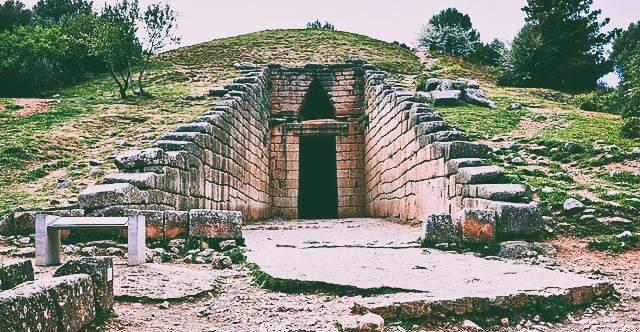
A Doorway to the Past
Nestled into a hillside, about 500 meters southwest of the ancient citadel of Mycenae, lies the Treasury of Atreus – an entryway to a long-lost world. Mycenae, located in the north-eastern Peloponnese, was one of the most powerful centres of Bronze Age Greece, famed for its monumental architecture and wealth. This tomb, built over 3,000 years ago, is more than just a relic; it’s a window into the lives, beliefs, and ambitions of the Mycenaean civilisation at its peak.
The Treasury of Atreus is one of nine “beehive” tombs at Mycenae, representing the zenith of Mycenaean funerary architecture. Its vast size and intricate design tell the story of Mycenaean power and societal hierarchy. But it’s more than a marvel of engineering—it’s a testament to human ingenuity, power, and belief.
What secrets does this tomb hold? How does it connect us to the people who lived and ruled in ancient Mycenae? Let’s step inside and uncover the extraordinary world of the Treasury of Atreus.
The Tholos Tomb : An Architectural Marble
The Treasury of Atreus was first excavated in 1876 by the German archaeologist Heinrich Schliemann, famous for his excavations at Mycenae and Troy. Schliemann, who was obsessed with the idea of uncovering the real-world settings of Homer’s epics, saw the Treasury as a monumental find that reinforced his belief in the historical basis of the Trojan War and the grandeur of Mycenaean civilization. While his methods were often controversial and his assumptions were almost certainly wrong, Schliemann’s excavation of the Treasury helped to establish Mycenae as a key site in understanding the power and sophistication of Bronze Age Greece. Subsequent excavations and studies have built on Schliemann’s initial work, revealing more about the tomb’s purpose and its role in the broader cultural and political context of the time.
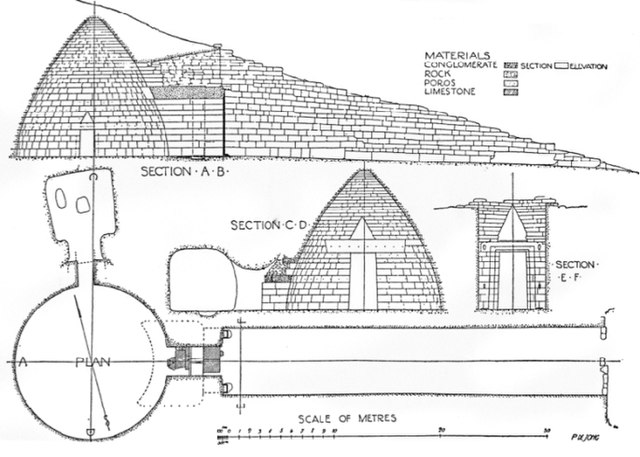
The Treasury of Atreus is a stunning example of Mycenaean architectural ingenuity. The tholos tomb stands as one of the most impressive burial structures of its time, marking the apex of Mycenaean funerary design. Unlike typical burial chambers, the tholos is a circular, domed structure, constructed using corbelled vaulting – a technique where layers of stone are gradually set inward to create a smooth, arching dome. This allowed the Mycenaeans to achieve the vast, 14.5-metre diameter chamber, which, at 13.6 metres high, remains one of the largest and most impressive of its kind.
The tomb is remarkable for its impressive feats of engineering. The structure was carefully built into the hillside, with a mound of earth used to compress the dome, reinforcing its stability. The dromos, or entryway, leads visitors down a 36-metre-long path, flanked by monumental stone walls, which heightens the sense of anticipation and ritual importance before reaching the grand entrance. Once inside, the vastness of the chamber itself evokes the power and wealth of those buried within—likely the elite of Mycenaean society.

A Walk Through Time
The dromos, stretching 36 meters long, invites visitors into the tomb, its narrow passage flanked by towering, weathered stone walls that seem to press in from either side, amplifying the sense of anticipation. The gradual narrowing of the path, combined with the looming stones overhead, heightens the ritualistic experience, making each step toward the tomb’s entrance feel heavier with meaning.
At the grand entrance, the sheer scale of the doorway commands attention. The colossal lintel above, made of stones that have weathered millennia, exudes an almost otherworldly presence, as if it were a threshold between life and death. Inside, the vastness of the circular chamber overwhelms the senses. The acoustics seem to hum with the faintest memory of ancient chants, the echoes lingering long after you’ve moved. The cool, damp air of the tomb contrasts with the warmth of the sun outside, adding to the atmosphere of sacred reverence. The towering dome, constructed from layers of stone, looms above – its smooth, corbelled vault creating a visual sensation of extraordinary weightlessness. The tomb feels alive with history, each stone, every silence, speaking to the Mycenaeans’ awe and respect for those they buried here.
A Tomb of Power and Belief
The Treasury of Atreus is not just a burial site; it is a symbol of the Mycenaean elite’s power, wealth, and religious beliefs. The sheer scale and sophistication of the tomb reflect the hierarchical nature of Mycenaean society, where monumental structures were often reserved for the most powerful individuals – likely the ruling class. The tholos tombs, with their massive stone construction and elaborate design, were a way to assert the importance of the individuals buried within, showcasing their social status long after death. The effort required to construct such a tomb, including the demolition of nearby houses and the transportation of fine stone from distant parts of Greece, points to the extensive resources controlled by the elite.
Beyond its political and social implications, the tomb also reveals Mycenaean beliefs about the afterlife. While there is no direct evidence of specific burial rituals associated with the tholoi, the ceremonial dromos and the monumental nature of the tomb suggest a deep concern with preparing the dead for their journey into the afterlife. The tomb’s massive scale and intricate design may have served as both a reflection of the deceased’s importance and a means of ensuring their status in the next world. In this way, the Treasury of Atreus stands as a testament to the Mycenaeans’ blend of power and belief, intertwining their physical and spiritual worlds.
Legacy of the Treasury
Despite centuries of looting and destruction, the Treasury of Atreus endures as a symbol of Mycenaean achievement. Its architectural brilliance and engineering feats continue to captivate scholars and visitors, offering a glimpse into the advanced culture of Bronze Age Greece. The tomb’s design, with its corbelled vault and massive lintel, marks the height of Mycenaean funerary architecture and has influenced later Aegean constructions.
But the legacy of the Treasury of Atreus extends beyond its physical form. It stands as a testament to the Mycenaean elite’s desire to make an indelible mark on history—blending power, belief, and artistry in a monumental expression of their worldview. As a window into the social hierarchy and religious practices of the time, the tomb helps us understand the complexities of ancient Mycenaean culture, continuing to inspire those who seek to unlock the mysteries of the past.
Sources
Castleden, R. (2005) The Mycenaeans, London.
Cline, E., ed. (2012) The Oxford Handbook of the Bronze Age Aegean, Oxford.
Dickinson, O. (1994) The Aegean Bronze Age, Cambridge.
Schofield, L. (2007) The Mycenaeans, Malibu.
Shelmerdine, C. ed. (2008) The Cambridge Companion to the Aegean Bronze Age, Cambridge.
Wace, A (1923). Excavations at Mycenae § IX — The Tholos Tombs. The Annual of the British School at Athens.
Wace, A. (1926). The Date of the Treasury of Atreus. The Journal of Hellenic Studies.
 Curious George